
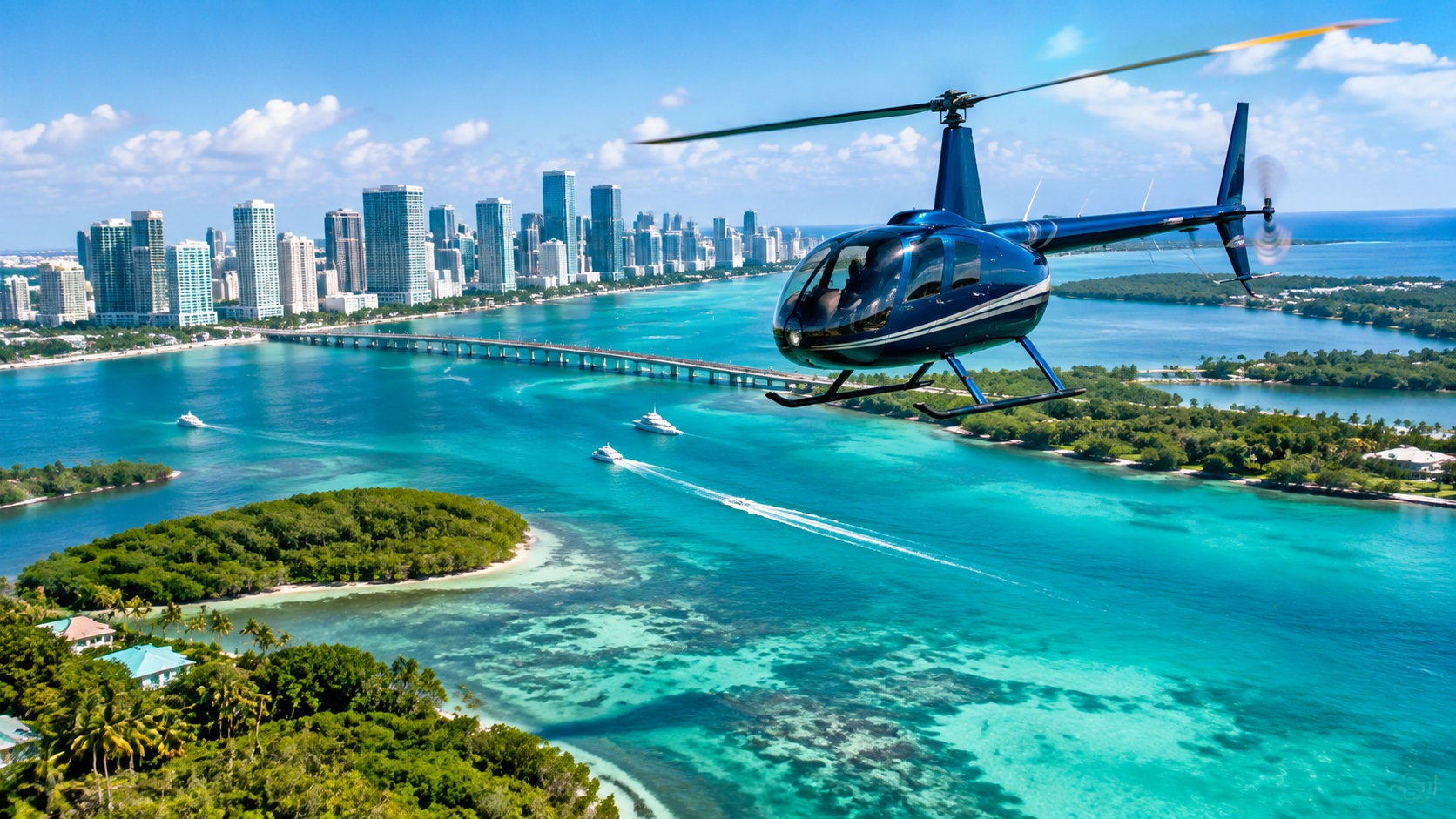
Why Choose a Sky Helicopter Tour in Miami
Top reasons to fly
A sky helicopter tour in Miami is the fastest way to wrap your head around the city’s sprawl. In as little as 12–20 minutes you can trace the pale curve of South Beach, skim the glassy towers of Downtown and Brickell, and swing past the mangroves and turquoise shallows of Biscayne Bay. From the air, Miami clicks into place: the grid of Ocean Drive, the cruise ships at PortMiami, the sandbar parties and yacht traffic, the color bands of reef and deep water.
The views are the headline. South Beach looks like a film set from 800 feet up. Key Biscayne stretches like a green arm into the Atlantic, capped by the white Cape Florida Lighthouse. Downtown’s skyline—One Thousand Museum’s Zaha curves, the Adrienne Arsht Center, the Kaseya Center—jumps out in one pass. You’ll see patterns you can’t from a car or a boat: tidal cuts, barrier island lagoons, causeways stitching islands to mainland, and the honeycomb of the Venetian Islands.
Time matters on a Miami trip. If you’ve only got a half-day before your cruise or a conference break between sessions, a helicopter gives you the reel of Miami’s greatest hits without the traffic or a full-day excursion. And the photos? Unreal. Water clarity, urban geometry, and Florida light do most of the work—you just press the shutter.
Who it’s best for
First-time visitors who want the lay of the land, couples marking an occasion, families with teens, and photographers who chase angles do especially well on these flights. If you’re deciding where to spend more time—South Beach or Brickell, Key Biscayne or Wynwood—a helicopter preview helps triage your itinerary. It’s also a sharp choice for proposals, anniversaries, or birthday surprises; many operators can arrange private flights and a toast on landing.
Best Time to Fly Over Miami
Seasonal tips
Miami has two big seasons for flying: dry and wet. From November through April, humidity dips and skies tend to be clearer. That means crisper views and fewer pop-up storms. There are still occasional cold fronts and breezy days, but visibility often hits its annual best. From June through September, afternoon thunderstorms are common; mornings are usually calmer and clearer. Always check the forecast—wind, ceilings, and storm potential matter more for helicopters than they do for your beach day. For regional marine and storm outlooks used by captains and pilots alike, consult the National Weather Service forecast before you book or head out.
Daylight vs. sunset
Light changes Miami. Golden hour pours warmth onto glass towers, pulls texture out of the water, and gives the sand a glow—great for romantic flights and video. Sunset departures also run cooler than the midday heat. If you want that electric, Caribbean-blue water color, fly mid-morning to early afternoon when the sun is high; be ready for stronger shadows on the skyline and a bit more heat in the cabin. Night flights (where offered) swap water color for city sparkle—bridges lit like necklaces, cruise ships aglow, and the runway ballet of MIA and Miami Executive in the distance.
Popular Routes and Iconic Sights
Classic loops
Most operators lift from Miami Executive (TMB) or Opa-locka (OPF) and run loops that pair coastline with skyline. Expect variations of these classics:
- South Beach Sweep: West to the coast, then a north–south pass along the Atlantic side from South Pointe up past Lummus Park, the Art Deco district, and the bandshell. You’ll see Ocean Drive’s pastel blocks, beach volleyball courts, and sandbars rolling into bright teal water.
- Downtown and Bay: Cut across Government Cut toward PortMiami, circle the cruise terminals, then trace Biscayne Boulevard and Brickell’s high-rises. Brickell Key looks like a chess piece from above; the Miami River twists through Overtown and Little Havana.
- Islands and Mansions: A low, smooth loop over Star Island, Palm, Hibiscus, the Venetian Islands, and Fisher Island. Expect megayachts, Mediterranean roofs, and lawns clipped to within an inch of their lives.
- Key Biscayne and the Cape: Southeast to Virginia Key and Crandon Park, past the Cape Florida Lighthouse at Bill Baggs Cape Florida State Park, then out over the flats toward Stiltsville—those candy-colored houses on pilings anchored in clear water.
Hidden gems
On a clear day you can pick out Stiltsville’s crooked footprint near the edge of Biscayne National Park. To the north, a tight loop over the Julia Tuttle and MacArthur Causeways reveals the intricate grid of marinas and spoil islands. If seas are calm and sun high, the shallow banks on the bay side show off patch reefs, turtle grass, and boat trails etched into the flats—patterns made for wide-angle shots. Ask your pilot to angle over Matheson Hammock’s atoll pool, the Vizcaya estate gardens, or the rusty industrial drama of the FEC slip by the port if you like a contrast of nature and city.
Tour Types and Duration Options
Shared vs. private
Shared flights keep the price down. You’ll join other passengers, the route is fixed, and seating is assigned for balance. Private flights cost more but buy you flexibility—custom routes, a say in where to linger, and a cabin to yourselves. If a window seat or doors-off setup is a must for your photos, book private and specify it when reserving.
Flight lengths
You’ll usually pick from three buckets:
- 12–20 minutes: A tight highlight reel—South Beach and Downtown, then back. Great if you’re on a lunch break or want a test run.
- 30–45 minutes: The sweet spot. Enough time to do South Beach, Downtown/Brickell, the islands, and Key Biscayne without rushing.
- 60 minutes: A proper grand tour with room to double back for photos, swing wider over the bay, or trace more coastline toward Bal Harbour or down toward Cutler Bay.
Doors-on is standard, which keeps the cabin quieter and cooler. A few operators offer doors-off flights for photographers; wind and noise jump, but reflections vanish and shots get clean. Add-ons can include narrated headsets, a glass of champagne on landing, hotel transfers, or a lounge where you can wait out a passing shower.
Pricing, Fees, and Value Tips
What affects price
Prices scale with time in the air, aircraft size, and demand. As a ballpark in Miami:
- 12–20 minutes: from about $129–$189 per person on a shared tour; $249–$399 private for two.
- 30–45 minutes: roughly $229–$399 per person shared; $499–$799 private for two to three.
- 60 minutes: $499+ per person shared (rarer), or $899–$1,299 private.
Sunset tends to carry a premium. Helicopters with larger cabins (like R44s versus R22s) or turbine ships command more. Watch for extras: heliport or security fees ($10–$35 per person), fuel surcharges ($10–$25), and photo/video packages. Taxes are usually added at checkout.
Ways to save
Weekdays and midday slots are often cheaper than golden hour. If you’re flexible, ask about last-minute seats on shared flights. Bundling a helicopter with a boat cruise, Everglades airboat, or art district walking tour can shave money off each experience. If you’re in town for a cruise, look for pre- or post-cruise packages with transfers from PortMiami or Miami International (MIA).
Safety Standards and Operator Credentials
What to verify
When you shop operators, ask straight questions. Do they fly under FAA Part 135 for on-demand charters? How many hours do their pilots have in type? What’s their maintenance schedule and who performs it? You should receive a safety briefing before boarding that covers seat belts, headsets, doors, and emergency procedures. Clear weight and balance policies, honest seating explanations, and recent, detailed reviews that mention communication and professionalism are all green flags.
Weight limits vary by aircraft; many tours set per-seat maximums around 275–300 lbs and total cabin limits around 500–600 lbs. If you’re close, disclose it during booking so they can plan fuel and seating. Operators may ask you to step on a scale at check-in—this is standard across the industry for safe loading.
Weather policies
Helicopters are nimble, but weather calls the shots. Ask about minimum visibility and ceiling requirements, how they handle gusty winds, and what triggers a delay or scrub. Good companies offer to reschedule or refund if conditions won’t allow a safe, comfortable tour. During summer, watch afternoon thunderstorm patterns and seabreeze timing; morning flights reduce the risk of pop-ups. The NWS forecast is a useful, plain-language read on wind, showers, and storm chances for South Florida days.
What to Expect on Flight Day
Check-in and briefing
Arrive 30–45 minutes early. You’ll show ID, complete a waiver, and step on a scale. Loose items—scarves, hats, open bags—get secured or left behind. Staff will run through the safety talk and show you how to wear and adjust the aviation headset. Photos on the ramp are usually okay after the crew says so; stay behind the marked lines until you’re escorted.
Seating is assigned to keep the helicopter within balance limits. Window seats aren’t guaranteed unless you’ve booked private or pre-arranged. If you’re shooting video, ask the pilot to keep turns smooth; they generally do, but a heads-up helps.
In-flight comfort
Cabins are snug. Wear light layers—you’ll feel a breeze during doors-off flights and air conditioning can be cool in winter. Closed-toe shoes are best on the ramp. Headsets cut most of the noise and let you talk to the pilot; keep chatter light during takeoff and landing. If you’re motion sensitive, sit up front or on the side that’s into the turn; looking at the horizon and keeping your camera steady helps.
Photography and Video Tips
Gear choices
A phone with an ultrawide lens is enough for skyline and coastline. If you bring a camera, think wide and fast: a 16–35mm on full-frame (or 10–22mm APS-C) covers most shots. A polarizing filter helps cut glare through doors-on plexi; skip it on doors-off to avoid vignetting at wide angles. Strap everything—neck or wrist straps keep gear from knocking against the cabin, and tethers are required on doors-off flights. Ditch loose lens caps and hoods.
Shooting techniques
Use fast shutter speeds (1/1000s or faster) to freeze vibration and rotor wash. In aperture priority, bump ISO until you get the shutter speed you want. Turn off flash. If you’re shooting through doors-on windows, place the lens hood against the plexi and shoot at a slight angle to kill reflections; wear darker clothes to keep your reflection out of frame. For video, set your phone to high-resolution 4K, 60 fps if available, and airplane mode to avoid call interruptions. Pan slowly, then hold the frame for a beat. Ask the pilot for a second pass on key landmarks if traffic allows—many will oblige.
Popular Departure Points and Logistics
Where flights take off
Most Miami helicopter tours depart from Miami Executive Airport (TMB) in Kendall or Miami-Opa Locka Executive Airport (OPF) north of Downtown. Both are about 25–40 minutes by car from South Beach depending on traffic. Some operators include parking; rideshare pickup/drop-off is straightforward at both fields. Build in buffer time—highway slowdowns are common around rush hour.
Routing and air traffic
Pilots coordinate routes with air traffic control. Expect altitude adjustments and minor detours for airline arrivals into MIA or when the port is busy. If cruise ships are maneuvering, the pilot may hold a little farther off their path. These tweaks rarely spoil the view; they often add variety.
Booking, Policies, and Accessibility
Lead times
For a sky helicopter tour Miami visitors should book 1–2 weeks ahead, longer for sunsets, weekends, and holiday periods like Art Basel, New Year’s, and spring break. If your dates are firm and you’re angling for a private, doors-off flight, lock it in as early as you can.
Cancellations
Read the fine print before you reserve. Common policies allow free changes or cancellations up to 24–72 hours in advance, with non-refundable windows inside that. Weather cancellations are typically refunded or rebooked at no charge. If you’re cruising, see whether a ship delay triggers exceptions.
Accessibility and age minimums
Ask about step stools, ground assistance, and door width if mobility is a concern; some aircraft have roomier cabins and easier boarding than others. Lap infants are usually not allowed on helicopters; operators often set minimum ages between 2 and 5 years with their own seat and belt. If you use a service animal, confirm policies and required documentation ahead of time.
For IDs, bring a government-issued photo ID for adults. International travelers should carry a passport. Share any medical or motion concerns during check-in; crews appreciate the heads-up and can seat you accordingly.
How to Choose the Right Tour
Match the route to your priorities
If it’s your first time, pick the 30–45 minute loop that ties South Beach, Downtown/Brickell, the islands, and Key Biscayne together—it covers Miami’s “postcard” set. Photographers who want reef color and Stiltsville angles should aim for clear late mornings with light winds. Celebrating? Book sunset, go private, and ask for a slow pass along the Cape and a double over South Pointe.
Compare the add-ons that matter
Headset narration makes a difference if you love context and landmark IDs. Doors-off matters if you’re fighting window reflections. Champagne is nice; priority boarding and guaranteed front seat are nicer if photos are the goal. If budget is tight, shave minutes rather than switch to a smaller, cramped aircraft—comfort pays off in better shots and a calmer ride.
Sample Itineraries That Pair Well
Half-day hit list
Morning helicopter from OPF, brunch in the Design District, Wynwood Walls walk, then beach time in the afternoon. Or flip it: a midday flight for cobalt water color, lunch in Brickell, and a Biscayne Bay boat cruise at sunset to change your vantage point.
Coast-and-keys combo
Fly Miami one day, then head south for snorkeling and sandbar time. If you’re continuing to the Upper Keys, keep an eye on the NWS marine forecast for wind and sea state; calmer water means clearer snorkeling at places like Grecian Rocks and the reefs off Key Largo.
Common Questions
Will I get a window seat?
Window seats aren’t guaranteed on shared flights because pilots must balance the aircraft. On private flights, you can choose seating—another reason they’re popular with photographers.
How bumpy is it?
On a light-wind day, the ride is smooth with gentle banking turns. Thermals and sea breeze can add light chop in the afternoon, especially over land. If you get queasy, avoid a heavy meal beforehand and ask for the smoothest route.
Can we fly over Biscayne National Park?
Tours commonly skirt the park’s northern shallows for views of Stiltsville and the flats. You won’t land in the park on a helicopter tour; access to its reefs and islands is by boat under park rules explained by the National Park Service.
What should I wear?
Light layers, closed-toe shoes, and minimal loose accessories. For photos, darker, matte clothing reduces reflections on doors-on flights.
What can I bring?
Phone, small camera, one lens, and ID. Leave loose scarves, hats, and open tote bags behind. If you booked doors-off, bring a strap for every device; the crew may require it.
Final Tips for a Flawless Flight
Pick your light first, then your length. Book early if you want sunset or doors-off. Confirm policies on weight, ages, IDs, and weather before you pay. Aim for a clear morning in winter or a golden-hour slot with scattered clouds. Show up early, travel light, and have a shot list in your head: South Pointe and the curve of the beach, the checkerboard of the Venetian Islands, the arc of Brickell’s skyline, the white spike of the Cape Florida Lighthouse, and the stilt houses in the flats. A sky helicopter tour Miami visitors rave about doesn’t happen by accident—it’s planned, then enjoyed. Once you lift, let the city arrange itself beneath you and keep your finger on the shutter.
Short flights of 12–20 minutes typically run about $129–$189 per person on a shared tour, or $249–$399 private for two. Mid-length 30–45 minute flights are roughly $229–$399 per person shared, or $499–$799 private for two to three, while 60-minute options are $499+ per person shared (rarer) or $899–$1,299 private. Sunset often costs more, and you may see extra heliport/security fees ($10–$35), fuel surcharges ($10–$25), and taxes at checkout. Most tours are offered in 12–20 minute, 30–45 minute, and 60 minute options. The 12–20 minute flights cover a quick highlight reel of South Beach and Downtown. The 30–45 minute window is the sweet spot for South Beach, Downtown/Brickell, the islands, and Key Biscayne, while 60 minutes allows a grand tour with time to double back or stretch farther along the coast. Most operators depart from Miami Executive Airport (TMB) or Opa-locka Executive Airport (OPF). From there, they typically run coastline-and-skyline loops tailored to flight length, covering areas like South Beach, Downtown/Brickell, Biscayne Bay, and Key Biscayne. From November through April generally offers clearer skies and crisper views, while June through September often has calmer, clearer mornings before afternoon thunderstorms. For golden, romantic light and cooler temps, aim for sunset; for the brightest Caribbean-blue water color, fly mid-morning to early afternoon. Night flights (where offered) trade water color for city lights and illuminated bridges. Classic loops showcase South Beach, PortMiami and Government Cut, Downtown and Brickell, the Venetian and Star/Palm/Hibiscus Islands, Fisher Island, and Key Biscayne with the Cape Florida Lighthouse. Many routes also sweep over Biscayne Bay’s shallow flats and, on clear days, Stiltsville’s houses on pilings. Ask pilots about angles over spots like Matheson Hammock, Vizcaya’s gardens, or the causeways for varied shots. Yes—many tours set per-seat maximums around 275–300 lbs and total cabin limits around 500–600 lbs. Operators often verify weights at check-in to ensure safe loading, so disclose if you’re close to limits during booking. Clear weight and balance policies and seating explanations are good safety signs.Frequently asked questions
How much do Miami helicopter tours cost?
How long are Miami helicopter tours?
Where do Miami helicopter tours take off from?
When is the best time to take a helicopter tour in Miami?
What will I see on a Miami helicopter tour?
Do Miami helicopter tours have weight limits?